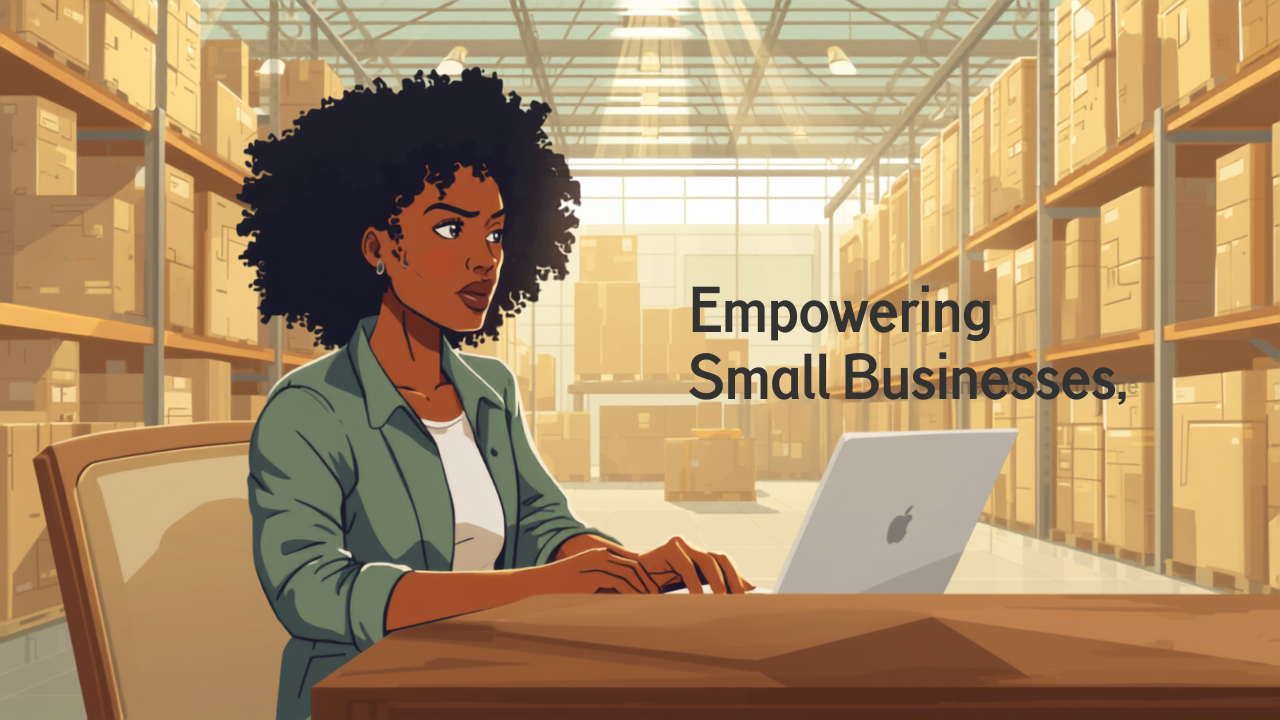
A small importer in Accra running $2 million in annual import volume asked me which supply chain software they should buy. I asked them what their biggest problem was. "I never know where my shipment is until it's already at port - and by then I've already paid demurrage." That's a visibility problem, not a supply chain management problem. The right tool was a shipment tracking platform at $150/month, not a $50,000/year ERP supply chain module.
The mismatch between SME supply chain problems and enterprise software solutions is pervasive. Small businesses don't need most of what enterprise platforms sell. They need specific capabilities that solve specific problems - at prices that make financial sense for their scale.
What Small Businesses Actually Need From Supply Chain Software
The supply chain challenges most common to small and medium businesses (SMBs) with 5-50 employees and $1-20M in annual import/export volume:
- Shipment visibility: "Where is my shipment?" is the question operations teams at small importers spend the most time answering - via emails to freight forwarders, phone calls to carriers, and manual checks of carrier tracking portals.
- Document management: Customs documents, bills of lading, certificates of origin, phytosanitary certificates - managing these across email threads and shared drives creates compliance risk and administrative overhead disproportionate to company size.
- Purchase order tracking: Linking supplier POs to shipment status so procurement can see whether ordered goods are on schedule without calling operations.
- Inventory visibility: Basic tracking of goods in transit versus goods received, so finance can forecast cash flow and procurement can time reorders.
- Freight cost tracking: Comparing quoted versus actual freight costs, tracking demurrage and accessorial charges, reconciling against carrier invoices.
The SMB Software Stack: Three Tiers
Tier 1: Minimal Viable (Under $200/month)
For businesses with under $3M annual import volume and fewer than 50 active shipments at any given time:
- Shipment tracking: A multi-carrier tracking platform (Portcast, Project44 SMB, or carrier-direct portals with consolidated view)
- Document storage: Organized cloud storage (Google Drive or SharePoint with defined folder structure) is sufficient if volume is low
- Basic inventory: A well-structured spreadsheet with version control, or entry-level tools like Cin7 Core or inFlow at $100-200/month
Tier 2: Growing SMB ($200-800/month)
For businesses with $3-15M annual volume and 50-200 active shipments:
- Logistics platform: A unified system that connects shipment tracking, document management, and PO tracking
- Inventory management: Cloud-based inventory software with barcode support if warehouse operations are involved
- Freight audit: Invoice verification against contracts, either manual or automated
Tier 3: Upper Mid-Market ($800-3,000/month)
For businesses approaching $20M+ volume with complex supplier networks or multi-modal shipments:
- Integrated logistics and customs platform: Combining tracking, compliance documentation, and duty management
- ERP with supply chain module: If financial integration complexity justifies it
- Supplier portal: For managing supplier document submission and performance tracking
What to Avoid When Buying Supply Chain Software as an SMB
Avoid: Over-Featured Enterprise Platforms
Enterprise supply chain suites charge for capabilities that take 12-18 months to implement and require dedicated IT resources. For an SMB, you'll pay for the license while implementation drags, and you'll use 20% of the features when you go live. Start with tools that work out of the box in days, not months.
Avoid: Platforms Without Integration APIs
If the platform you buy can't talk to your ERP, your freight forwarder's system, or your e-commerce platform, you've created a new silo, not solved an old one. Always verify API availability before purchasing.
Avoid: Per-User Pricing That Punishes Growth
Some platforms charge per user seat at rates that become prohibitive as you add team members. For a 10-person company that needs 8 people to have shipment visibility, per-user pricing of $50/user/month = $400/month minimum. Shipment-volume-based or flat-rate pricing is more predictable for growing teams.
Supply Chain Software for Small Business Frequently Asked Questions
At what point does a small business need supply chain software?
The practical threshold: when you're managing more than 20-30 active shipments at any given time and tracking them manually is taking more than 4-6 hours per week across your team. Below that volume, disciplined spreadsheet management is often sufficient. Above it, the time cost of manual tracking usually justifies even entry-level software. A secondary trigger: when a customs delay or missed shipment has cost you more than a year's software subscription.
Is affordable supply chain software reliable enough for mission-critical logistics?
Cloud-based logistics platforms serving SMBs have improved dramatically in reliability. The key metrics to check: uptime SLA (look for 99.5% or better), data backup frequency, support response time, and carrier connectivity (how many carriers and ports does the platform track?). "Affordable" doesn't mean unreliable - many platforms serving SMBs have enterprise-grade infrastructure because they serve enterprise subsidiaries and larger players on the same platform.
Can small businesses use supply chain software without an IT department?
Modern cloud-based supply chain platforms are designed for self-service implementation. A non-technical operations manager with 2-4 hours of setup time can configure entry-level tools, connect carrier accounts, and start tracking shipments. The platforms that require IT departments for implementation are enterprise systems designed for companies with IT departments. SMB platforms assume no internal IT resources.
What is the ROI calculation for supply chain software for a small importer?
Calculate: (annual cost of demurrage and detention fees) + (freight forwarder charges for status inquiries) + (staff time spent on manual tracking at hourly rate) + (cost of stockouts or emergency air freight from missed shipments). For most importers doing $2M+ in annual volume, this total easily exceeds $20,000-50,000/year. Software at $150-500/month ($1,800-6,000/year) that reduces this waste by even 30% produces positive ROI. Build this calculation with your actual numbers before any vendor demo.
How does small business supply chain software differ from enterprise platforms?
Key differences: (1) Implementation time - SMB tools go live in days, enterprise in months. (2) Customization - SMB tools offer configurable out-of-box workflows, enterprise tools require custom configuration. (3) Support model - SMB tools offer self-service documentation and chat support; enterprise tools require dedicated customer success managers (included in the price). (4) Integration model - SMB tools offer pre-built integrations with common systems; enterprise tools require custom API development. (5) Pricing - SMB tools charge by volume or flat rate; enterprise tools charge by module and user with significant implementation services.
Key Takeaways
- Start with the specific problem costing you the most money - demurrage, missed shipments, or manual tracking time - not the most feature-rich platform.
- The practical threshold for supply chain software investment is 20-30 active shipments requiring more than 4-6 hours of manual tracking per week.
- Cloud-based SMB logistics platforms go live in days, not months - no IT department or custom implementation required.
- Build the ROI case before any demo: add up annual demurrage fees, emergency air freight costs, and manual tracking labor hours.
- Avoid per-user pricing that becomes prohibitive as you add team members - volume-based or flat-rate pricing is more predictable for growing teams.
Want enterprise-grade shipment visibility at SMB-accessible pricing? See how QueChains works for growing import and export businesses.
Written by the QueChains Editorial Team
Talk to our team about how QueChains can transform your supply chain operations.