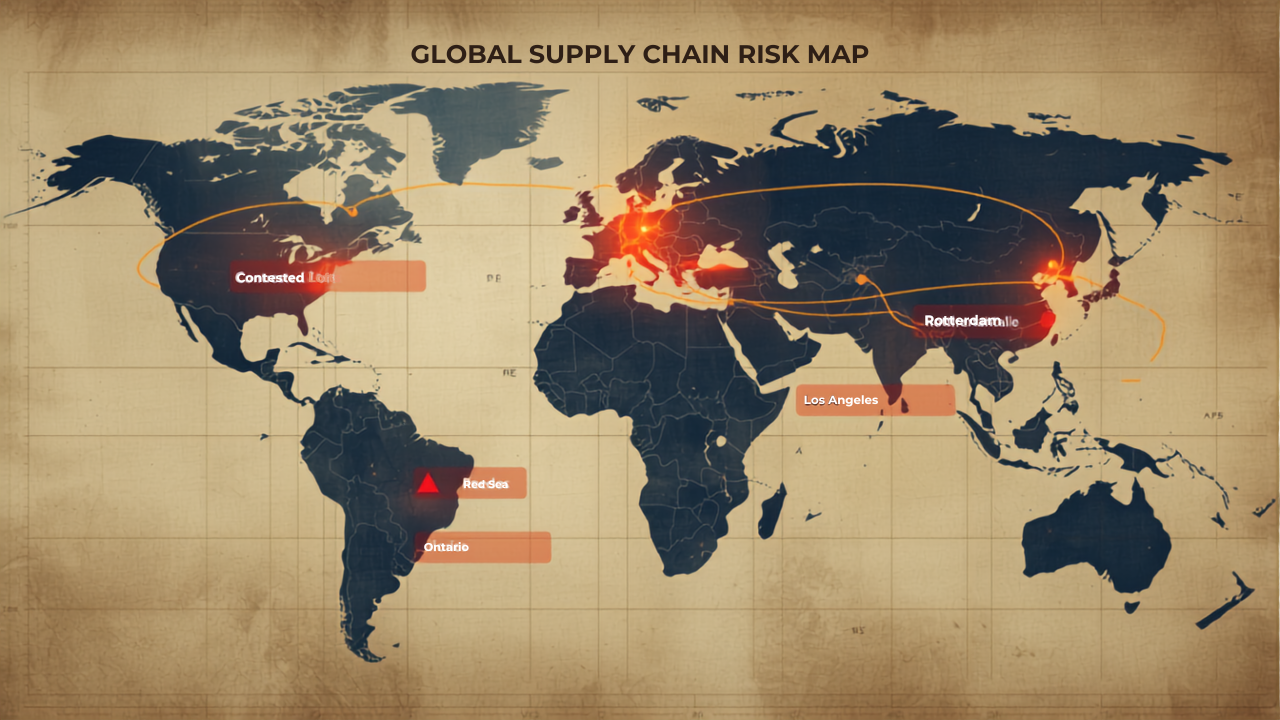
In 2021, a single ship blocking the Suez Canal for six days cost global trade an estimated $9.6 billion. In 2022, semiconductor shortages idled automotive production lines that had zero components sourced from Asia. In 2024, Red Sea attacks rerouted a significant portion of container traffic around the Cape of Good Hope, adding 10-14 days to Europe-Asia transit times.
None of these events were unforeseeable. Suez Canal blockages had happened before. Semiconductor concentration risk had been documented for years. Geopolitical risk in the Red Sea corridor was visible months before disruptions began. The difference between companies that absorbed these shocks and those that didn't isn't luck - it's whether they had a functioning supply chain risk management program before the disruption hit.
What Supply Chain Risk Management Actually Involves
Supply chain risk management (SCRM) is the identification, assessment, and mitigation of risks across your supply network - from raw material sources through manufacturing, logistics, and final delivery. Most companies do a version of this reactively: something goes wrong, they fix it. SCRM makes it proactive: identify what could go wrong before it does, and have responses ready.
The risk categories that matter for most supply chains:
- Supply risks: Supplier failure, single-source dependency, raw material scarcity, supplier financial distress
- Operational risks: Production disruptions, quality failures, capacity constraints, equipment breakdowns
- Logistics risks: Port congestion, carrier failures, customs holds, infrastructure disruptions
- Geopolitical risks: Trade policy changes, tariffs, sanctions, conflict zones, export controls
- Environmental risks: Natural disasters, climate events, extreme weather affecting transport corridors
- Financial risks: Currency volatility, supplier financial health, commodity price swings
- Cyber risks: Ransomware attacks on suppliers or logistics providers, data breach supply chain attacks
The SCRM Framework: Four Phases
Phase 1: Risk Identification and Mapping
You cannot manage risks you haven't identified. Supply chain mapping - documenting every node in your supply network, including tier-2 and tier-3 suppliers - is the foundation. Most companies have good visibility to tier-1 (direct suppliers) but poor visibility to tier-2 (their suppliers' suppliers). Many of the most damaging disruptions originate at tier-2 or below.
Risk identification tools: supplier questionnaires, spend analysis, process mapping, industry incident databases, and geographic concentration analysis. The output should be a visual supply chain map with risk annotations for each node and corridor.
Phase 2: Risk Assessment and Prioritization
Not every risk deserves equal attention. Prioritize using two dimensions: probability (how likely is this to occur?) and impact (if it occurs, how severe is the effect on your operations?). A risk heat map plots risks across these dimensions. High probability + high impact = immediate mitigation required. Low probability + low impact = monitor, don't resource.
Quantify impact where possible: revenue at risk per day of disruption, alternative sourcing cost premiums, customer penalty exposure. This converts abstract risks into financial figures that justify mitigation investment to senior management.
Phase 3: Risk Mitigation Strategy
Four generic mitigation strategies, applied based on risk severity:
- Avoid: Eliminate the risk source. Example: exit a sourcing corridor with chronic port congestion.
- Reduce: Decrease probability or impact. Example: qualify a second supplier for a single-sourced component.
- Transfer: Share the risk with a third party. Example: purchase cargo insurance, negotiate force majeure clauses.
- Accept: Consciously carry the risk with a response plan ready. Example: maintain safety stock for a low-probability, high-impact disruption.
Phase 4: Monitoring and Response
Risk management without monitoring is a one-time exercise that ages out of relevance quickly. Effective monitoring combines internal triggers (supplier performance data, inventory levels, order backlogs) with external signals (geopolitical news, port congestion data, weather alerts, financial news on key suppliers).
Supply Chain Risk Management Software: Core Features
The SCRM software market has matured significantly since 2020. Key capabilities to evaluate:
- Supply network visibility: Tier-1, 2, and 3 supplier mapping with geographic concentration analysis
- Risk scoring: Automated supplier financial health scores, country risk ratings, and disruption probability models
- News and event monitoring: AI-powered scanning of news, regulatory changes, and industry incidents affecting your supplier network
- Scenario modeling: What-if analysis for specific disruption types (port closure, supplier bankruptcy, trade restriction)
- Incident management: Structured workflow for managing active disruptions from initial alert through resolution
- Integration with logistics platforms: Real-time shipment data feeds for in-transit risk monitoring
Supply Chain Risk Management Frequently Asked Questions
What are the most common supply chain risk management mistakes?
The four most frequent failures: (1) Mapping only tier-1 suppliers - most catastrophic disruptions originate deeper in the supply chain. (2) Treating SCRM as a compliance exercise - annual risk reviews that produce reports nobody acts on. (3) Ignoring concentration risk - multiple suppliers in the same geographic region create correlated risk that looks like diversification but isn't. (4) No pre-approved response playbooks - when disruptions hit, teams waste days deciding how to respond instead of executing pre-built contingency plans.
How do you quantify supply chain risk for CFO-level conversations?
Convert risk scenarios to financial impact: (daily revenue at risk) - (probability of disruption) - (expected duration in days) = annual expected loss. For a manufacturer with $2M daily revenue, a 15% probability of a 5-day supplier disruption = $1.5M annual expected loss. Compare that to the cost of mitigating actions (dual sourcing, safety stock, insurance). The math usually makes SCRM investment obvious.
What is a business continuity plan for supply chain?
A supply chain business continuity plan (BCP) documents your response to specific disruption scenarios: which suppliers to activate, which logistics routes to use, which customers to prioritize, which orders to delay, who has authority to make emergency decisions, and what the communication protocol is. The plan should be scenario-specific (not generic), pre-approved by leadership, and tested via tabletop exercises at least annually.
How does geopolitical risk monitoring work in SCRM software?
Modern SCRM platforms use AI-powered news monitoring to scan thousands of sources (news feeds, government announcements, port authority updates, sanctions lists) and surface events relevant to your specific supply network. If a supplier is located in a country where a new export restriction is announced, the platform flags it. If a key shipping corridor experiences a security incident, shipments transiting that corridor are highlighted. The platform doesn't replace human judgment - it ensures the relevant information reaches the right people before they hear about it from a customer.
What's the difference between supply chain risk management and supply chain resilience?
Risk management focuses on preventing disruptions - identifying risks and taking actions to reduce their probability or impact. Resilience focuses on recovering from disruptions quickly when they do occur - the organizational capabilities, supplier relationships, and process flexibility that allow rapid adaptation. Both are necessary. Risk management without resilience is brittle; resilience without risk management is reactive. The best supply chain programs invest in both simultaneously.
How do small and medium businesses approach SCRM without dedicated resources?
Start with the highest-impact, lowest-effort actions: (1) Map your top 10 suppliers and identify which are single-sourced. (2) Check the financial health of your top 5 suppliers using public data or credit agencies. (3) Review your logistics corridors for concentration - if 80% of your freight moves through one port, that's a risk. (4) Build a simple response plan for your most likely disruption scenario. SCRM doesn't require enterprise software to start. It requires structured thinking and documentation of what you already know.
Key Takeaways
- Supply chain risk management is no longer optional - geopolitical, environmental, financial, and cyber risks have all increased in frequency.
- The four SCRM phases are: risk identification and mapping, assessment and prioritization, mitigation strategy, and ongoing monitoring.
- Map tier-2 and tier-3 suppliers, not just direct suppliers. Most catastrophic disruptions originate deeper in the supply network.
- Quantify risk in financial terms - daily revenue at risk multiplied by probability and duration - to justify investment to leadership.
- Pre-approved response playbooks are what separate companies that absorb disruptions from those that are paralyzed by them.
Want real-time disruption alerts for your shipment corridors? See how QueChains monitors logistics risks as they emerge.
Written by the QueChains Editorial Team
Talk to our team about how QueChains can transform your supply chain operations.