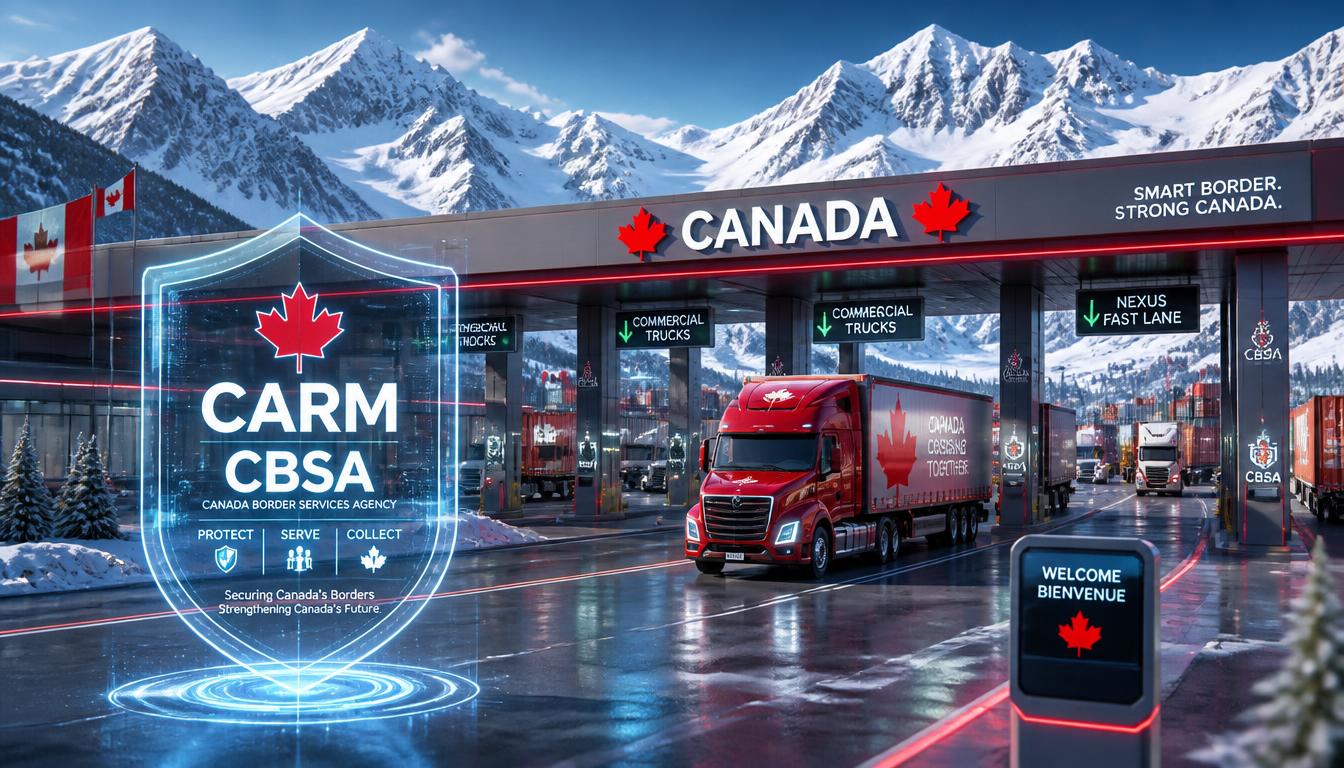
A regular importer of industrial parts in Ontario recently faced a rude awakening at the border. For ten years, they had relied entirely on their customs broker to handle every aspect of Canada Border Services Agency (CBSA) compliance, including paying duties on their behalf. Suddenly, their shipment was delayed because they hadn't registered in the new CARM Client Portal and hadn't secured their own Release Prior to Payment (RPP) bond.
The transition to the CBSA Assessment and Revenue Management (CARM) system represents the biggest change to Canadian commercial importing in decades. It shifts financial liability directly onto the importer of record, fundamentally changing the dynamic between importers and customs brokers.
Whether you're a first-time importer or a seasoned veteran who hasn't fully adapted to the CARM era, this guide details exactly how to clear goods through Canadian customs today.
The CBSA Import Process: What You Need to Know
To import commercial goods into Canada, you need more than just a commercial invoice. You need a verified importer identity and financial security in place with the government.
Step 1: Your Business Number and CARM Registration
Before you can import anything, you need a Business Number (BN) with an import/export account (RM extension) from the Canada Revenue Agency (CRA). Once you have this, you must register your business in the CARM Client Portal. This is no longer optional. Through CARM, you will delegate authority to your customs broker, view your statements of account, and manage your duty payments directly with the CBSA.
Step 2: The RPP Bond Requirement
Under the new CARM regulations, importers who want their goods released before they pay duties and taxes must post their own financial security. Previously, you could piggyback on your broker's bond. Now, you need your own Release Prior to Payment (RPP) bond. Without it, you will have to pay a cash deposit or pay duties at the border before CBSA will release your cargo, causing massive delays.
Step 3: The B3 Customs Coding Form (or CARM Equivalent)
The customs declaration itself (traditionally the B3 form, now managed via the Commercial Accounting Declaration within CARM) details the origin, tariff classification, and value of the goods. This determines the duties and taxes owed. Accurate classification according to the Canadian Customs Tariff is critical; misclassification is the leading cause of CBSA audits and AMPS (Administrative Monetary Penalty System) penalties.
Duties, Taxes, and Free Trade Agreements
Importing into Canada isn't just about duties; it's heavily focused on the Goods and Services Tax (GST).
GST on Imports
Most commercial goods imported into Canada are subject to the 5% federal GST, calculated on the duty-paid value of the shipment. While you can typically claim this back as an Input Tax Credit (ITC) if you are a GST-registrant, the cash flow requirement is immediate at the time of import.
CUSMA (USMCA) and Preferential Tariffs
If you are importing goods manufactured in the United States or Mexico, you can usually import them duty-free under the Canada-United States-Mexico Agreement (CUSMA). However, "origin" doesn't just mean "shipped from." The goods must meet strict rules of origin, and you must hold a valid Certification of Origin at the time of import. Don't claim CUSMA if you don't have the proof; CBSA audits this aggressively.
Frequently Asked Questions
What is CARM and how does it affect importers into Canada?
CARM (CBSA Assessment and Revenue Management) is the digital initiative modernizing how the CBSA assesses and collects duties and taxes. The biggest impact for importers is that they must now register directly in the CARM portal, manage their own financial security (RPP bonds), and pay the CBSA directly, rather than routing payments solely through their broker. It shifts financial liability firmly onto the importer.
How long does customs clearance take at Canadian ports/borders?
For compliant shipments with advance electronic data filed correctly and no required permits, release can happen within hours. However, if the CBSA flags your shipment for examination, or if you lack an RPP bond requiring a cash transaction at the port, delays can range from 2 to 7 days, incurring costly storage fees.
Do I need a customs broker to import into Canada?
While CBSA allows self-clearance (filing your own declarations), most commercial businesses use a licensed customs broker. Brokers navigate the complex tariff classifications and manage the digital transmissions to CBSA. Even under CARM, where you manage the financial side, brokers remain essential for their classification expertise and operational handling.
How are Canadian import duties and taxes calculated?
Duties are calculated based on the product's tariff classification (from the Canadian Customs Tariff) applied to the value for duty (usually the transaction value). After duties are added, the 5% GST is applied to that total duty-paid value. Some goods, like basic groceries or prescription drugs, may be zero-rated for GST.
What is a CBSA RPP bond and do I need one?
A Release Prior to Payment (RPP) bond is financial security posted with the CBSA. It guarantees that you will pay your assessed duties and taxes. Under CARM, importers must obtain their own RPP bond to get their goods released before payment. The bond amount is generally based on 50% of your highest monthly accounts receivable over the past year (minimum $25,000).
How do I find the correct tariff classification for goods entering Canada?
You use the Canadian Customs Tariff schedule. If you are uncertain about a classification, you or your broker can request an Advance Ruling for Tariff Classification from the CBSA before you import. This ruling is binding and protects you from misclassification penalties at the border.
What goods are prohibited or restricted from import into Canada?
Canada strictly controls the import of firearms, weapons, certain used vehicles, and hate propaganda. Restricted goods require permits from other government departments (OGDs). For example, agricultural products need CFIA permits, and health products require Health Canada approval. Always verify OGD requirements before shipping.
How does CUSMA (USMCA) affect duty rates for goods from the US?
CUSMA eliminates tariffs on most goods originating in the US or Mexico. However, you must prove the goods meet the specific rules of origin outlined in the agreement. You need a Certification of Origin (which can be included on the commercial invoice) containing specific data elements. Without this proof, standard duty rates apply.
Key Takeaways
- Register for the CARM Client Portal immediately and secure your own RPP bond; you can no longer rely on your broker's bond for release prior to payment.
- Accurate tariff classification is your responsibility. Misclassification leads to AMPS penalties and holds.
- Understand the difference between "shipped from the US" and "originating in the US." CUSMA requires proof of origin, not just a US shipping address.
- Ensure your commercial invoices clearly state the value, currency, country of origin, and detailed product descriptions to prevent border delays.
Managing Canadian imports under CARM requires precision and visibility. See how QueChains connects your shipment tracking directly with your compliance documentation.
Written by the QueChains Editorial Team
Talk to our team about how QueChains can transform your supply chain operations.